WiiTH — Social Meetup MVP: A UX & Product Design Case Study

B2C Social Platform · Taiwan · UX / Product Designer · Early-Stage MVP

WiiTH — Social Discovery App

Role

UX / Product Designer

Type

B2C social platform · Social discovery

Stage

Early-stage MVP

Overview

A Taiwan-based social app that rewards showing up together. Users scan each other's QR at meetups to mint Friend Coins, redeemable at partner cafés, gyms and event spaces.

Unit of value: real-world presence — not matches or messages. Different from Meetup (event-led) and dating apps (1:1 swipe). MVP: one QR meetup loop + merchant redemption.

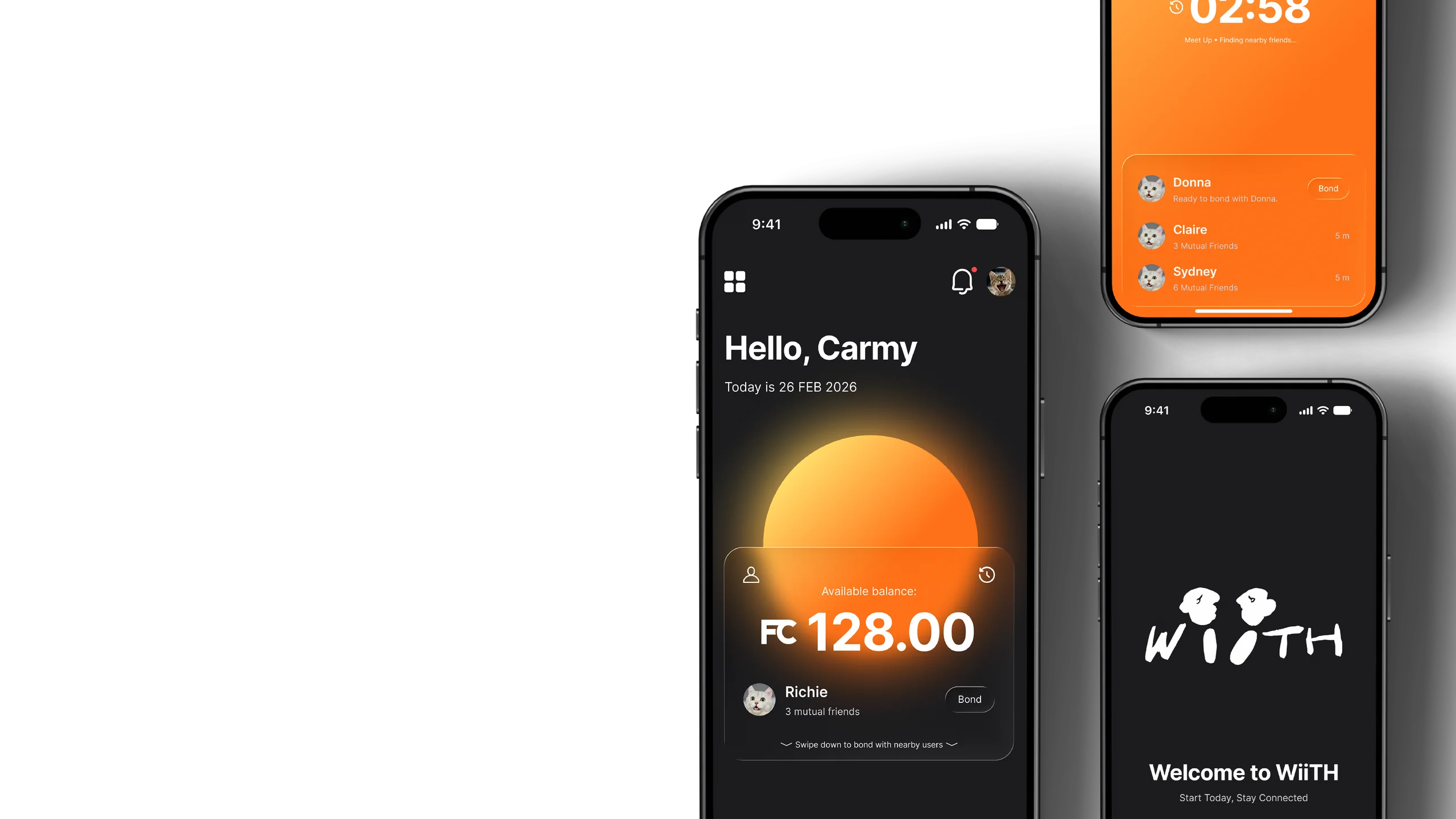
WiiTH screen poster

Make showing
up matter.

Real-world presence — valued, rewarded, habitual. The foundation of social life, not a novelty.

Problem & Insight

Social and dating apps optimise for what they can measure — matches, messages, time-in-app. None of those guarantee what users actually want: a real meeting in real life.

If the product can't make the offline meetup easier and more rewarding than the chat, it has already lost.

Audience

Teens & young adults in Taiwan — endless swipes, dying group chats, plans that never happen.

Existing alternatives

Meetup feels too event-led. Dating apps are 1:1 and transactional. Neither rewards just showing up.

Open scope

No prescribed goals. Users pick any activity — friends, dates, families, communities all welcome.

  • Cost of not meeting is zero; reward for meeting is invisible
  • Insight: the meetup itself — not the match — is the unit worth designing for
  • Goal: make showing up the most rewarding thing the app can measure

The Pivot

The original vision was untestable with our team. We reframed the core insight and cut scope to a single QR meetup loop we could ship and learn from.

V0 — Vision

Slow AI Dating

One AI match at a time, GPS proximity, in-app events. 6+ months to first ship.

Reframe

Meetups, not Matches

The real problem isn't matching — it's plans that never happen. Reward the meetup itself.

MVP — Shipped

QR + Friend Coins

QR meetup confirmation → redeemable credits at partner merchants. Testable in weeks.

Constraints that shaped every decision

Engineering capacity

2 part-time engineers. Anything beyond a few sprints had to be deferred.

No real user data

Pre-launch. Decisions reasoned from first principles, not analytics.

Shifting scope

Founder vision moved between dating, events, and rewards.

Trust & privacy

Anything resembling surveillance would kill teen adoption.

Product Workflow

Designing the journey before the screens.

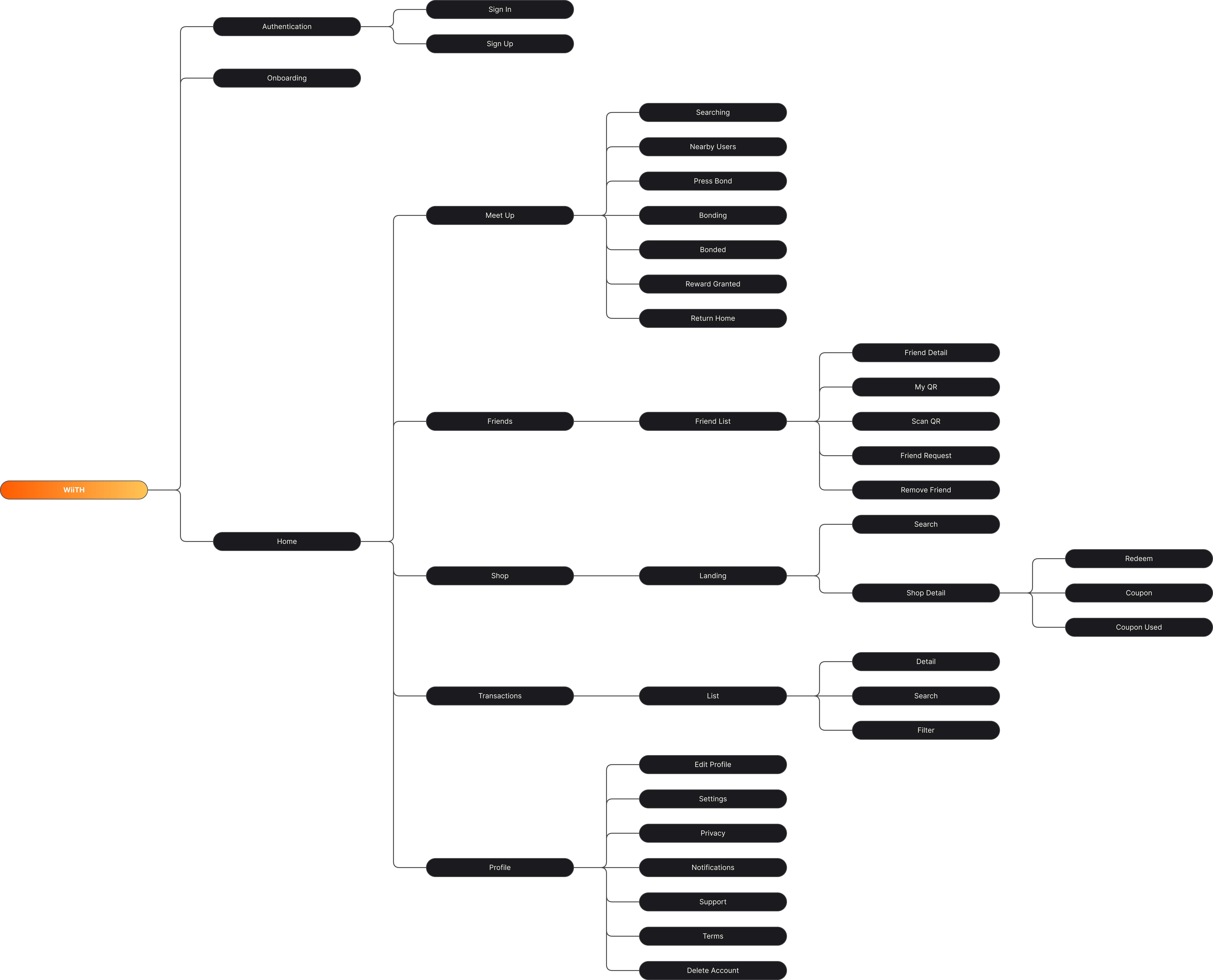
Before designing individual screens, I mapped WiiTH as one connected journey — from onboarding and meeting someone in real life to friendships, rewards and redemption. This exposed missing states early and gave every screen a clear purpose within the wider product.

WiiTH product workflow map

Design System

Built around behaviour, not just screens.

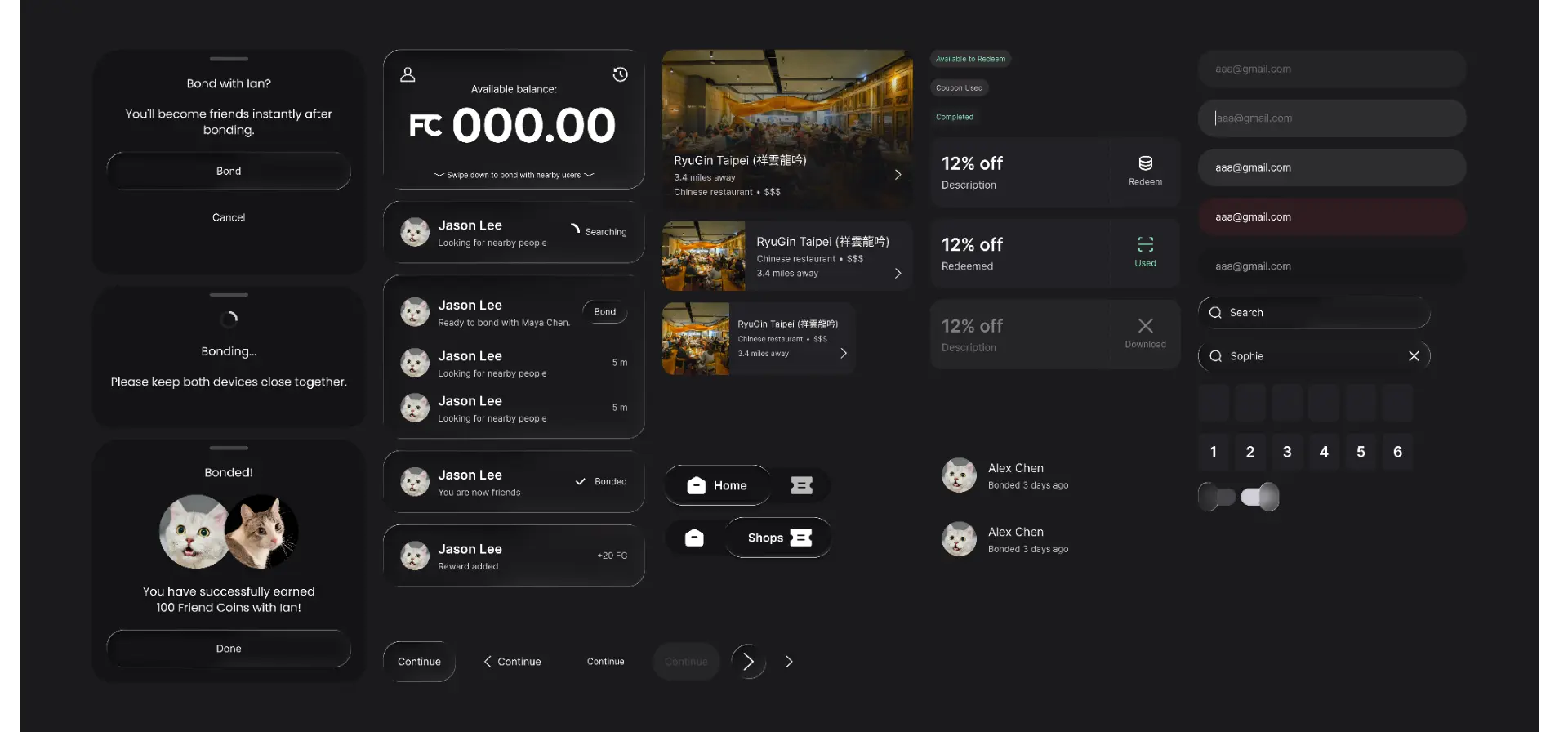
As WiiTH grew across onboarding, Meet Up, friends, shops and rewards, I built a shared component system so new flows could reuse the same interaction patterns instead of being designed screen by screen. Components were defined around meaningful states, from input feedback to the full Meet Up journey, keeping the experience consistent as the product expanded.

One system, multiple journeys.

WiiTH component system

MVP Strategy

Prove a small tangible reward is enough to make young people meet up — and that local merchants will pay for the resulting foot traffic.

Everything else cut.

01

QR Meetup Loop

Two users scan each other → both receive Friend Coins. Mutual scan = mutual intent. Zero background tracking.

Trigger

Mutual QR scan

Reward

Friend Coins

Privacy

No background tracking

02

Merchant Redemption

Coins redeem at partner cafés, gyms, events — anchoring digital action to physical value.

03

Loopholes Open

Observe behaviour first. Validate demand before adding enforcement.

Phase 2 — Frictionless Presence

Documented, not dropped

GPS Passive Detection

Opt-in proximity + co-location duration → auto Friend Coins.

Event Infrastructure

Group QR, multi-participant invites, auto reward distribution.

Subscription Rituals

Recurring meetups (weekly dinners, fitness) with streaks & multipliers.

Key Decisions

Five points where ambition collided with reality. One was load-bearing — the rest, supporting trade-offs.

01

QR over GPS Co-Location

The Load-Bearing Decision

Problem

Auto-detecting meetups via background GPS would drain battery, hit OS privacy walls, fail indoors, and be easy to spoof.

Decision

Ship a mutual QR scan handshake. Defer passive detection to Phase 2.

Why

Mutual scan = mutual intent. Zero background tracking. Familiar pattern, zero learning curve.

Trade-off

Adds one deliberate action — but buys trust, reliability, and a testable reward loop.
02

QR Loopholes

Problem

Two users could fake-scan to farm Friend Coins.

Decision

Observe first. Defer enforcement.

Why

If it's worth hacking, it's worth building. Coins only redeem at merchants — even abuse drives foot traffic.

Trade-off

Accepting some early gaming in exchange for shipping speed and real signal.

03

Progressive Onboarding

Problem

A long sign-up form killed conversion.

Decision

One input per screen, auto-advance.

Why

Form felt like a conversation, not a wall. Reduced perceived effort, lowered drop-off.

Trade-off

More screens to build, but dramatically higher completion.

04

Seed Merchants First

Problem

Two-sided cold start: rewards app is worthless if no merchants nearby.

Decision

Onboard cafés, gyms and venues before users.

Why

First scan unlocks something redeemable nearby — instant payoff, no empty-app problem.

Trade-off

Slower public launch in exchange for a working reward loop on day one.

05

Privacy by Default

Problem

Proximity-based social features can easily feel like tracking.

Decision

No background location. Presence is only used when the user actively enters the Meet Up experience.

Why

WiiTH should help people find each other intentionally, not monitor where they go.

Trade-off

Less passive discovery, but clearer consent and greater user control.

Outcome

MVP launched in Taiwan with a small set of partner merchants. Without mature analytics, the honest measure of impact is what changed for the team — and what it unlocked next.

Scope clarity

Cut the buildable surface from a dating + AI + GPS platform to a single QR meetup loop.

Faster delivery

Onboarding and QR flow spec'd as small, independent pieces — engineers shipped in parallel.

Investor traction

A working MVP turned investor conversations from concept pitch into product walkthrough.

Merchant pipeline

Anchoring rewards in redemption gave founders a concrete pitch: foot traffic.

Trust by default

QR over silent GPS pre-empted the privacy objections that derail teen-facing apps.

Honest roadmap

GPS, events and rituals weren't dropped — documented as Phase 2 with constraints to solve first.

The most useful thing design did on WiiTH wasn't the screens — it was turning a moving vision into a buildable product the team could agree on.

Reflection

Startup product design is mostly subtraction under ambiguity. Three takeaways shaped how I now approach early-stage work.

01

Cut to the smallest testable claim.

"Slow dating with AI matching and GPS" isn't a hypothesis — it's four. Reframing it to "will a small reward make people meet up?" made the project shippable.

02

Constraints are the brief.

Part-time engineering and zero analytics weren't problems to design around — they were the brief. The QR-first MVP only makes sense when those constraints are taken seriously.

03

Trustworthy beats clever.

QR over invisible GPS wasn't the cleverer answer — it was the trustworthy one. In a teen-facing product, trust compounds faster than novelty.

Tensions held

Growth

vs

Control

Incentives

vs

Authenticity

Friction

vs

Verification

Vision

vs

Buildability

© 2026 Victor Chu. All rights reserved.